Behavior & Enrichment
How to Read Your Cat's Body Language: Tail, Ears, Eyes, and Purring
Published September 16, 2026Last reviewed September 16, 2026
Cats talk with their whole bodies, and most of the messages are quieter than people expect. Once you learn to read the tail, ears, eyes and sounds as one sentence, the "mysterious" cat becomes fairly predictable.
Three reading rules, in order
- Rule 1 · Tail first
- Rule 2 · Ears and eyes together
- Rule 3 · Read them as one sentence
You are stroking your cat's back. She is purring. Her tail, though, is twitching from side to side like a slow metronome. You keep petting. Thirty seconds later you have a polite nip on the wrist and a cat who has relocated to the far end of the couch, and you are genuinely confused about what you did wrong.
The answer was in the tail. That twitch is the feline version of a "please stop now" sign, and the purr you heard was not permission to keep going. Cats send messages in combinations (sound plus tail plus ears plus eyes), and reading any single signal on its own will mislead you. The good news is that cat body language is learnable, and it is more consistent than people give it credit for. A tail position, an ear set, and a pupil size mean roughly the same thing across most cats. This guide walks through the main channels one at a time, then shows how to read them together. By tomorrow you can run a short, practical check before you touch your cat.
The tail: the signal people misread most
The tail is the fastest channel to learn, partly because it is visible from across the room.
A tail held high with a slight curve at the tip is a confident greeting, the shape your cat's tail takes when you walk through the door after work.
If the tip quivers while the tail stays up, the greeting is excited. Some cats do this right before they lead you to the food bowl.
A slow, side-to-side swish usually means the cat is focused on something, often mildly annoyed by it. This is the tail from the opening scene. It means "I am tolerating this, but I would like it to end."
A fast thrash, or a tail that thumps against the floor, is a stronger warning. Whatever you are doing, that is the moment to stop.
A puffed tail (fur standing up along the whole length) means startled or afraid. The cat is trying to look bigger. The same reflex that fluffs the tail also arches the back. It can happen at a sudden noise, a new animal at the window, or a surprise touch. A tail tucked low, pressed against the body, signals fear, stress, or feeling unwell. A cat that walks around with its tail permanently tucked deserves attention. Check for pain or a recent change in the home.
One pleasant signal: a tail wrapped around your arm or leg is contact and affection, the feline equivalent of putting an arm around a friend's shoulder. And a tail tip twitching while the cat sits quietly is usually the cat deciding (often about whether that movement near it is prey, a threat, or nothing at all).
Ears: the mood board on top of the head
Ears are the second-fastest channel. They move constantly, and each position is easy to spot. Neutral, relaxed ears point forward and slightly outward. That is the resting position of a calm cat.
Ears forward, swiveling toward a sound or an object, mean interest. Your cat's ears are doing this right now if it is watching a bird through the window. Paired with wide eyes and a still body, this is the hunting posture.
"Airplane ears" (held out to the sides, like wings) mean uncertainty or mild stress. You see them when a new person enters the room or when the cat is deciding whether to approach something unfamiliar. It is not yet a threat, but the cat is not comfortable either. Flattened ears, pressed back against the head, are a fear or anger signal, or both. This is the prelude to a hiss, a swipe, or a bite. A cat with flattened ears should not be handled. Give it space and let it come out on its own terms.
Rapid swiveling from side to side means the cat is scanning for threats, the aural version of a security camera sweeping a room. It often goes with a tense body and dilated pupils.
Eyes: pupils, stares, and the slow blink
Cat eyes send three kinds of messages worth separating: pupil size, the stare, and the blink. Pupils tell you about arousal, not mood. Wide, dilated pupils mean the cat's nervous system is switched on, whether from excitement, fear, or intense focus. Slit pupils mean relaxed or focused attention. The catch is that light changes pupil size too, so pupils only make sense together with the ears and body. A cat stalking a toy mouse and a cat facing a dog can both have huge pupils, and the rest of the body tells you which one this is.
A hard, unblinking stare is a challenge. Cats stare at each other before fights, and your cat will stare at you the same way when it wants you to back off. Do not answer with your own hard stare. A slow blink, in contrast, is the opposite of a threat. When your cat looks at you and blinks slowly, it is telling you it trusts you. Blink slowly back. Most owners who try this find their cat starts slow-blinking within a few days, and it becomes a two-way greeting.
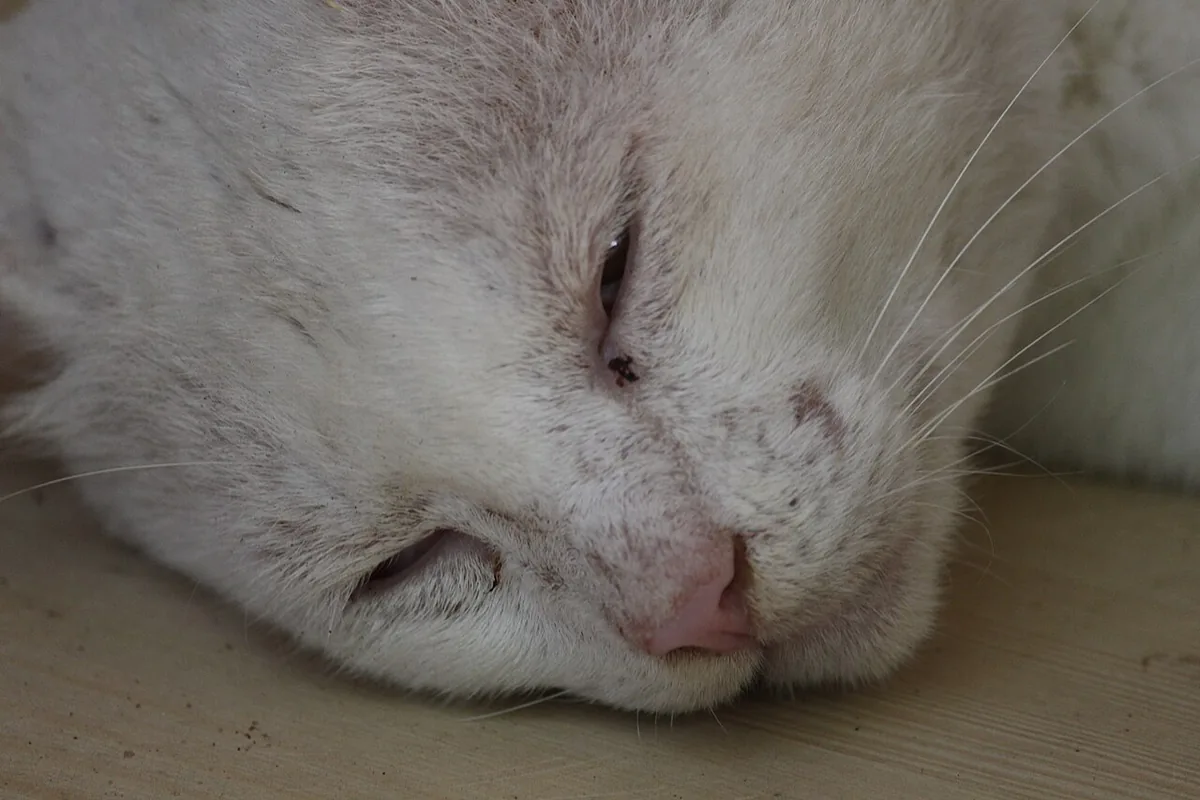
Half-closed eyes near you mean the cat is relaxed and safe, usually moments from sleep.
That droopy-lidded look is not boredom. It is a cat that does not feel the need to watch you.
Purring, meows, and the sounds around them
Purring is the signal people trust most and understand least. Cats purr when they are content, but they also purr when they are frightened, in pain, giving birth, or seriously ill. Purring appears to be a self-soothing behavior as much as a social one. So a purr alone proves nothing. A purring cat that is also relaxed, kneading, and soft-bodied is a happy cat. A purring cat that is tense, hiding, or sitting at the vet is using the same sound to calm itself down. Watch the rest of the cat before you believe the purr.
The meow is mostly reserved for humans. Adult cats rarely meow at each other. They meow at us, because it works. A short, chirpy meow is a greeting. A repeated, insistent meow with eye contact is a request, usually for food, water, or door service. A long, low-pitched meow is closer to a complaint. The ASPCA's cat behavior pages cover meowing and yowling in detail, and a sudden change in an older cat's voice is worth a vet visit rather than a training fix.
The other sounds are easier to place. A hiss or spit means fear or defensiveness: give space. A growl is a warning, often territorial. A trill (a short, rising chirrup) is a friendly greeting many cats use instead of a meow. Chattering at birds through the window is excitement mixed with the frustration of prey just out of reach. It is normal, and some cats do it at laser dots too. Yowling, especially at night in an older cat, is a distress call that deserves a vet check rather than a scolding.
Reading the whole cat before you decide
Every signal above changes meaning with context. The same arched back can be an invitation to play or a defensive warning, based on whether the cat presents it sideways to the threat. A cat lying on its side showing its belly looks like an invitation to rub, but for many cats the belly is a trap. The exposed position means trust, not "please touch the most vulnerable part of me." Start with the head and shoulders instead.
Whiskers add detail. Forward-pointing whiskers mean interest or curiosity. Whiskers pinned back against the face mean fear or defensiveness.
Whole-body combinations are more reliable than any single part. A cat with tail up, ears forward, and a slow blink is approachable. A cat with tail thrashing, ears flattened, and pupils wide is telling you to back off. A cat that is hiding, hunched, with a tucked tail, wants to be left alone regardless of what its mouth is doing. Context matters here as well. The same cat will send different signals in a new home, after a new pet arrives, or during a thunderstorm. If the body language changes along with a change in the household, the household is the story.
Common mistakes in reading cat body language
- Reading the purr as happiness only. Purring plus a tense body is a stress signal, and pushing through it is how owners get bitten "out of nowhere."
- Treating a tail swish like a dog's wag. A dog's wagging tail usually means excitement. A cat's fast tail is the opposite: irritation. The two species read the same body part differently, and swapping one reading for the other is the single most common error.
- Staring back at a staring cat. You are answering a challenge with a challenge. Blink slowly instead.
- Punishing fear. Hissing, hiding, and puffing are not "bad behavior." Punishing them just teaches the cat that you are part of the threat.
- Reading one signal instead of the combination. The tail said "stop" in the opening scene. The purr said "I am trying to stay calm." Only one of those signals was the message.
- Ignoring sudden changes. A normally outgoing cat that suddenly hides, stops eating, or starts yowling at night may be in pain. That is a vet question, not a body-language question.
Questions owners ask first
Why does my cat purr and then bite me? Usually because the petting went on too long. The purr may have been genuine comfort at first, but the tail and ears were sending "stop" for a while before the bite. The fix is to watch for the first sign of irritation (a tail twitch, an ear turn, a ripple of the skin) and end the session there, before the bite becomes necessary.
Is my cat wagging its tail like a dog? No. A fast, swishing tail in a cat is irritation or intense focus, not happiness. If you have been reading it the dog way, your cat has been trying to tell you something for a while. Why does my cat stare at me without blinking? It is either a challenge or intense focus on something near you. Answer with a slow blink, which signals trust, and watch whether the cat relaxes. If it stays rigid with flattened ears, move away slowly.
My cat's tail is always puffed. Is that normal? A chronically puffed tail means a cat that is frequently startled or threatened. Look for the trigger, such as a window with passing animals, a new pet, or loud noise. Removing the trigger matters more than reading the signal. If it appears alongside hiding or appetite loss, check with your vet. Can I read my cat's mood from a photo? Mostly, yes, if the photo catches the whole body (tail, ears, eyes, posture together). Single-part photos, like a close-up of just the face, lose the context that makes the signal readable.
The next 24 hours, in practice. Three small practices fit into this evening and tomorrow. Tonight, when your cat is relaxed, offer a slow blink and wait for one in return, which is the trust exercise. Tomorrow, take two minutes while your cat eats or sits at the window and name the tail position, the ear position, and the pupils out loud. And the next time you pet, stop at the first "quiet please" sign instead of waiting for the nip. Three days of that habit will tell you more about your cat than a month of guessing.
Where these signals are documented
- ASPCA, "Common Cat Behavior Issues": https://www.aspca.org/pet-care/cat-care/common-cat-behavior-issues
- ASPCA, "Cat Care": https://www.aspca.org/pet-care/cat-care
- Cornell Feline Health Center, "Feline Health Topics": https://www.vet.cornell.edu/departments-centers-and-institutes/cornell-feline-health-center/health-information/feline-health-topics
- Merck Veterinary Manual: https://www.merckvetmanual.com/
- AVMA, resources for pet owners: https://www.avma.org/resources-tools/pet-owners/petcare
Veterinary disclaimer
This guide describes signals that owners commonly see in healthy cats. It is not veterinary advice, so treat it as a starting point rather than a diagnosis. Talk to your veterinarian about any behavior change that worries you, especially one that comes suddenly. If your cat is injured, in obvious distress, or showing signs of a medical emergency, contact your vet or the nearest emergency animal clinic without delay.