Behavior & Enrichment
Cat Enrichment on a Budget: 15 Ideas from Household Items
Published September 14, 2026Last reviewed September 16, 2026
Enrichment does not need a pet-store budget. These fifteen ideas reuse cardboard, boxes, paper and other household items, each one comes with a safety note, and a simple rotation plan keeps them from going stale.
Fifteen ideas in four groups
- Boxes & tunnels
- Hunting games
- Scratching
- Rotation plan
It is Saturday morning. The cat has eaten, the litter box is clean, and you are on the couch with coffee. Ten minutes later the cat is on the bookshelf, staring at a blank wall. Fifteen minutes after that, it is chewing the corner of the cardboard box you were about to recycle. The cat is not broken. It is looking for something to do.
"Enrichment" sounds like something you order from a catalog. In practice it just means giving your cat outlets for the behaviors cats are built to do: investigate, hunt, scratch, climb, perch, and rest. Most of those outlets do not require a pet-store trip. With a few clean cardboard boxes, some paper, and your cat's regular food, you can put together a small rotation of activities that changes week to week.
Cats who live indoors depend on us for everything their ancestors got from a territory. That includes things to chase, places to watch from, and surfaces that feel right to scratch. When those are missing, cats invent their own versions, and the invented versions are usually less convenient than the planned ones. The ASPCA's cat-care pages describe the basics of what indoor cats need, and almost every item on its list has a household-item version.
A note before you start.
If your cat stops eating, stops using the litter box, hides more than usual, or shows any sudden change in behavior, book a vet visit before adding enrichment. Boredom and medical issues can look alike from the outside.
The fifteen ideas
Every idea below needs supervision the first time.
Watch how your cat interacts with the item, then decide whether it can stay out or has to go back into the rotation box between sessions.
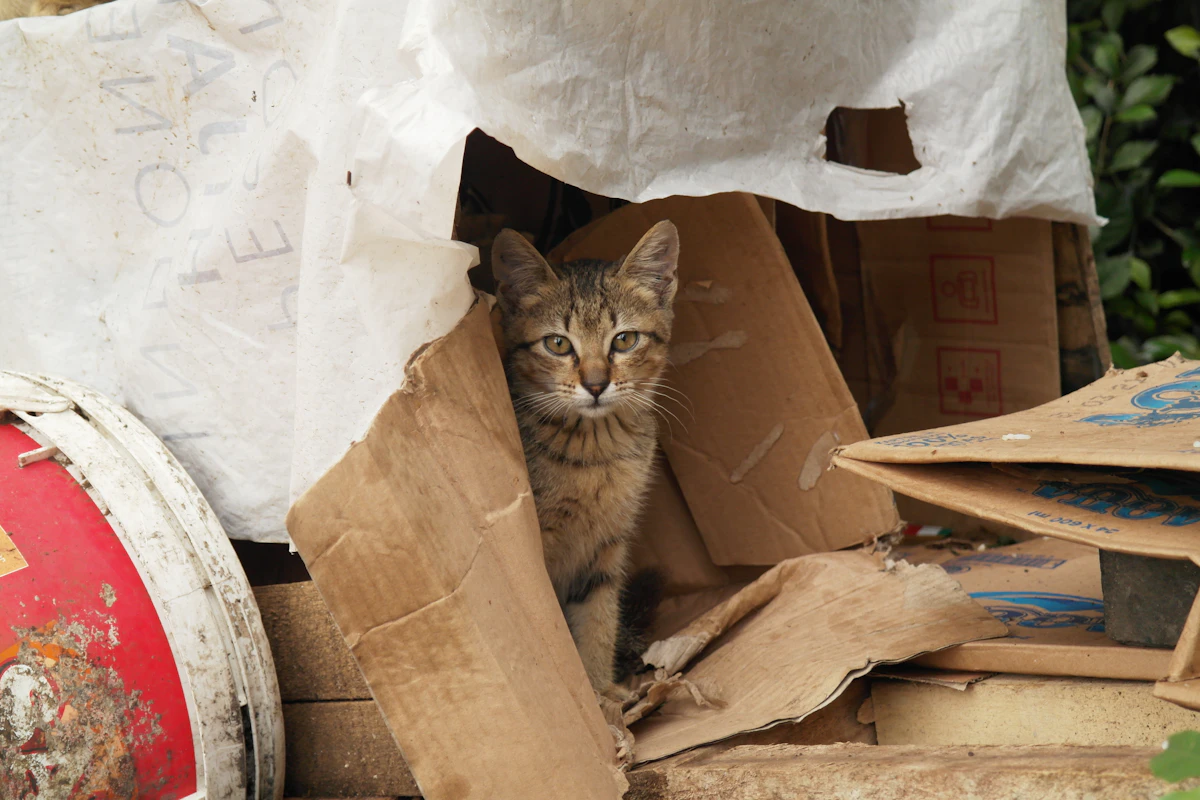
- Cardboard box fort. Tape two or three clean boxes together, cut round doors between them, and you have a tunnel-and-hide system. Cut a second door at a different height for variety. Cats use boxes for refuge and for peeking out at their territory, which is exactly what cat care guides list among basic needs. Safety: remove staples and pull tape away from any edge the cat can reach. Watch the first session to see whether your cat chews tape or cardboard, and retire boxes once they get soggy or frayed.
- Paper bag trail. Lay two or three brown paper bags flat on the floor and drop a single kibble into each. Your cat has to push through the opening to find it. Leave one bag half-open so the game has an easy start. Safety: cut the loop handles off first, loops are a strangulation hazard. Never use plastic bags. Supervise the session and store the bags away afterwards.
- Roll-and-tumble treat tube. Fold one end of a toilet-paper roll closed, drop in three or four pieces of kibble, and fold the other end. The tube rolls and rattles, and the cat bats it until it opens. Safety: supervise, and discard the roll as soon as it splits into pieces small enough to be swallowed. Swap in a fresh one every day or two.
- Egg carton treasure box. Drop kibble into the cups of a clean paper egg carton and close the lid, or flip the carton upside down so the food is hidden underneath. Pawing and nosing the carton open is the game. Leave one cup open at first so the cat learns that food lives in there. Safety: keep it to cardboard, no plastic egg cartons, and supervise if your cat pulls off and eats pieces of pulp.
- Muffin tin shell game. Put a few kibbles in the wells of a metal or silicone muffin tin and cover each well with a ping-pong ball or a loose ball of crumpled paper. Lifting the "shell" to find food is quiet, satisfying paw work. Start with two wells covered and work up from there. Safety: use balls big enough that they cannot be swallowed, and put the tin away between sessions.
- Bathtub ping-pong. Two or three ping-pong balls in a dry bathtub bounce and skid in ways that are hard for a cat to predict, which is exactly what makes the game worth watching. If you do not have a bathtub, a high-sided cardboard box works. Safety: dry tub only. Supervise so the balls are not chewed into pieces, and keep them out of reach when you are not playing.
- Scent hunt. Scatter ten to fifteen pieces of your cat's regular kibble across the floor or across a clean tray and let your cat track them down by smell. This is the cheapest possible version of a food puzzle. Hide a few pieces under paper or a towel corner to add a second step. Safety: vacuum or sweep afterwards, and subtract the scattered kibble from the next meal so your cat is not overfed.
- Corrugated cardboard scratch pad. Lay a flattened shipping box face-up on the floor, or glue two or three sheets of corrugated cardboard together into a pad. Scratching is normal feline behavior. The ASPCA lists stretching, marking, and play among its functions, so give it an approved surface. Lean it against a wall at a slight angle if your cat prefers vertical scratching. Safety: no exposed tape or staples. Replace the pad when it is frayed. If your cat chews and eats cardboard instead of scratching it, offer a different texture such as a sisal mat.
- Supervised wand toy. Tie about 60 cm of yarn to a wooden dowel or a sturdy stick, attach a few crumpled paper bits or a soft feather to the other end, and run a two-to-three-minute hunting game that you control. Move it like prey, not like a metronome. Short skids, pauses, and quick direction changes keep the cat tracking. Safety: this is the one idea in this list that is never a "leave it out" toy. Yarn and string can cause serious injury if swallowed, so it comes out only when you are holding it and goes into a drawer afterwards. Check for loose bits before every session.
- Sock catnip pouch. Fill a clean adult sock with a spoonful of dried catnip or crumpled paper, knot the end, and offer it as a kick-and-wrestle toy. Safety: not all cats respond to catnip, and that is normal rather than a sign of failure. Supervise if your cat chews fabric, and remove the pouch as soon as it tears.
- Window perch from a stool. A sturdy step stool, or stacked firm boxes, topped with a folded towel and placed beside a safe window gives your cat a lookout point with something to watch. Vertical space is one of the indoor needs that cat behavior guides highlight. Position it where birds or passers-by actually appear, not just where the window happens to be. Safety: the perch must be stable and non-slip, the window must be closed or secured, and the screen must be intact.
- Vertical step route. Clear a sturdy bookshelf or set up a small stepladder with a non-slip mat so your cat can move between high resting spots. Safety: remove anything breakable from the route, make sure every surface is stable, and leave nothing a cat could pull down onto itself.
- Frozen lick plate. Spread a thin layer of your cat's usual wet food on a flat plate or in a wide shallow bowl and freeze it for twenty to thirty minutes. Licking it slowly is calming and keeps the cat busy. Safety: use only food your cat already eats, offer it on a surface that is easy to clean, and retire the plate as soon as it chips.
- Paper crumple chase. Crumple two or three sheets of plain paper into loose balls and toss one a short distance. A few minutes of chase-and-pounce covers the same ground as a store-bought toy. Toss in different directions so the cat has to track the movement. Safety: supervise, remove the balls once they flatten and develop hard edges, and never use foil. Its edges are sharp and it is not digestible.
- The rotation box. A closed box where "off-duty" toys live. Each time you swap items, check them for wear and toss anything torn or shedding pieces. This is less a toy and more the system that keeps every other idea in this list fresh.
Match the ideas to your cat's stage of life
Kittens, adults, and seniors do not play the same way.
A kitten will attack the same crumpled ball six times in a row and call it a win. An adult cat may inspect a new item for ten minutes before touching it. A senior cat often prefers food-finding and licking games over pouncing ones, because they demand less speed and no sudden landings.
The household versions adapt easily.
For a kitten, keep sessions short and end them before the kitten is exhausted. For a senior, use the frozen lick plate and the scent hunt more, and keep the perch route low so jumping is optional. If you are not sure what fits your cat, the vet can point you to the right starting point during a routine visit.
The first week: introduce, watch, rotate
A cat presented with a room full of new objects at once may ignore all of them.
Bring out one or two items, leave them out for a day, and rotate. If your cat walks past something entirely, put it away and try again in a few weeks. Interest in objects changes with age and season.
Watch which type of play your cat actually returns to. Some cats are pouncers, some prefer pawing at food puzzles, and behavior guides describe how to match activities to the individual. Enrichment is about variety that fits the cat, not about volume. Cats notice new things most when old things disappear at the same time, so keep two or three items out at once, swap them every two to four days, and keep your cat's clear favorites in the mix. A rotation rhythm gives worn items a natural exit point, and each swap is a chance to inspect everything and retire anything frayed, torn, or shedding pieces.
In multi-cat homes, rotate for the group, not per cat.
Watch who plays with what during the first hour an item is out, and keep a duplicate of anything two cats fight over. A second sock pouch costs nothing and prevents a daily turf argument.
A realistic daily rhythm
Enrichment does not have to be a production. A common workday pattern looks like this. Morning: kibble goes into a treat tube or scent hunt instead of a bowl, which buys twenty minutes of quiet paw work. Midday: the window perch does the work while nobody is home. Evening: one wand-toy session of a few minutes, then dinner, then the frozen lick plate as a wind-down. The whole setup takes more thought than money, and the cat gets a day with four small events instead of one flat stretch of boredom. The rhythm matters more than the items, because a cat that knows something interesting happens every morning and every evening stops hunting for entertainment on its own schedule. It usually stops staging events on your counter at 2 a.m.
Common enrichment mistakes
- Leaving food puzzles out full and letting the cat graze all day. Time the puzzle with a meal and pick the pieces up afterwards.
- Repeating the same two items forever. A wand toy that comes out every day at the same time stops being interesting.
- Skipping the first safety check. A staple, a loop handle, or a plastic bag can turn a good idea into a vet visit.
- Using a new food in the puzzles. Stick to the regular diet so a change in appetite or digestion is not confused with a reaction to a new treat.
- Expecting every item to be a hit. Two out of three ideas getting ignored is normal, and the third is worth keeping.
- Treating enrichment as a substitute for interaction. A box of toys does not replace the daily play session where you are part of the game.
- Setting everything up at once and walking away. The first week is about watching how each item is used, not about decorating.
When enrichment is not the answer
Enrichment addresses boredom and unmet needs, not illness. If appetite, litter-box use, or sociability change suddenly, see a veterinarian before adding anything new. The same checklist that recommends perches and toys also covers the basics: at least one litter box per cat, cleaned daily, and a quiet resting area. Get those right first.
If the cat is healthy but still seems flat and uninterested in everything, including food, mention it at the next vet visit. Low energy can look like a personality trait when it is actually something medical, and the vet is the one who can tell the difference.
Questions owners ask first
Is it safe to leave boxes and paper out all the time? Only the ones your cat does not chew. Cardboard that stays dry and intact is fine to leave out for a few days. Anything that gets chewed, torn, or soggy moves to supervised sessions. Tape and staples are the real risks, so check every new item before it stays out.
My cat ignores everything I set up. What now? Try one item at a time instead of a pile, and use food. A scent hunt or treat tube almost always gets attention because it involves the regular meal. If your cat still walks past everything, watch what it already does at home. Some cats prefer heights, some prefer hiding, so build on that instead of the generic ideas.
My cat does not react to catnip. Is that a problem? No. Sensitivity to catnip is genetic, and roughly a third of cats show little or no response. The ideas in this list do not depend on catnip. Use food instead: the treat tube, the scent hunt, and the egg carton are all food-based.
I have two cats. Do I need double everything? Not everything, but anything they fight over. Start with the daily rhythm and watch the first hour each item is out. Duplicate the favorites (a second sock pouch, a second treat tube) and give each cat its own window perch so the high spots do not become contested territory.
How often should I change the rotation? Every two to four days is a good default. Change too often and the cat never gets comfortable. Change too rarely and the items go stale. Keep two or three items out at once, and always swap in at least one old favorite with any new item.
Your next 24 hours. Pick one cardboard box and one food idea from this list. Tonight, before dinner, run the scent hunt with ten pieces of regular kibble, the cheapest possible start, and it works for almost every cat. Tomorrow, set up the box fort or the window perch and watch how your cat uses it for five minutes. That is the whole first step: one food game, one box, and a decision about whether the next idea comes from the list above or from whatever your cat just showed you it prefers.
Where these ideas come from
- ASPCA Common Cat Behavior Issues: https://www.aspca.org/pet-care/cat-care/common-cat-behavior-issues
- ASPCA Cat Care: https://www.aspca.org/pet-care/cat-care
- ASPCA General Pet Care: https://www.aspca.org/pet-care/general-pet-care
- Cornell Feline Health Center, Feline Health Topics: https://www.vet.cornell.edu/departments-centers-and-institutes/cornell-feline-health-center/health-information/feline-health-topics
- AVMA Pet Owner Resources: https://www.avma.org/resources-tools/pet-owners/petcare
Veterinary disclaimer
The ideas on this page are everyday suggestions, not veterinary advice. Talk to your own veterinarian before changing how you feed, play with, or otherwise care for your cat, and keep that conversation in mind for any behavior concern. If you suspect a medical emergency, call your vet or the nearest emergency animal clinic right away.