Travel
Flying With Your Cat in Cabin: What to Check
Published September 12, 2026Last reviewed September 16, 2026
Flying with a cat in the cabin is mostly paperwork and carrier rules done in the right order. This checklist covers what to confirm with the airline, the vet documentation and the screening-day routine, and it starts with the rule that overrides every other: verify with your specific airline.
Verify before you bookCarrier rulesBooking orderVet & paperworkAirport day
The confirmation email says "pet in cabin confirmed," which is where most people stop reading. Then the check-in agent pulls out a tape measure, holds it against your carrier, and shakes her head. The dimensions changed last month. The flight still departs without your cat.
Every airline publishes a pet policy, and almost none of them stay still. Fees change, carrier sizes are recalculated, and a route that accepted cats one season closes its cabin to pets the next. That is why the most useful habit is not memorizing a number but running a short checklist against the carrier's current rules before you book. This guide gives you that checklist: what to verify, where to confirm it, and how to handle the vet paperwork and the airport day so nothing is discovered at the gate.
One rule sits above everything: the airline's current written policy is the only binding source. Check it before you book, then again before you fly.
Two questions to settle before you book
Does cabin travel suit your cat? Calm in a carrier for an hour at home is not the same as calm through a full travel day. If your cat has breathing problems, a flat face, or any medical condition, ask your veterinarian whether air travel is appropriate at all before you spend money on tickets. Sedation questions belong on the same vet visit, not in a forum thread.
Will the carrier fit the cabin allowance? Cabin pets travel in a carrier that must fit under the seat in front of you. If your cat and carrier exceed the allowance, cabin travel is likely off the table, and you will be deciding between cargo and ground transport instead. The ASPCA recommends a carrier large enough for the pet to stand, sit and turn around in.
Both questions deserve a vet visit, not a web search. The airline owns the numbers, your vet owns the health call. Ask both before anyone books a ticket.
A trial run at home tells you more than any checklist: an hour in the carrier, a car ride, a session in a busy lobby while the cat stays calm inside the carrier. If the cat cannot handle the carrier for the length of the flight plus airport time, the problem is the plan, not the cat.
Build a policy sheet: what to verify with your airline
Airlines change these details without much notice, so build the sheet from the airline's official pet page or a phone confirmation and write the date you checked next to each answer. When the numbers disagree with your booking page, the phone call wins.
| What to verify | Why it matters |
|---|---|
| Current carrier size limit | The maximum dimensions change. Some airlines treat soft-sided carriers more leniently because they compress. Ask whether the carrier must fit under the seat in front of you. |
| Weight limit, including the cat | Some airlines weigh pet plus carrier. Others do not. Confirm the number that applies to your booking. |
| Booking window and how to reserve | Cabin space for pets is usually limited per flight. Ask how far in advance you must book and whether the reservation is made by phone or online. |
| Route and aircraft restrictions | Codeshares, connecting flights and some aircraft types do not take cabin pets. International itineraries often have different rules than domestic ones. |
| Fees and refundability | Pet fees are charged per flight or per direction, and may or may not be refundable if you cancel. Ask for the amount that applies to your exact dates. |
| Temperature and breed embargoes | Some airlines suspend pet travel when ground temperatures are extreme, and some maintain breed restrictions. Ask specifically about your travel dates. |
The sheet has one job: to make the policy legible on the day. Print it, keep it with the confirmation, and re-check the top three rows (size, weight and booking window) 48 hours before departure, because those are the ones that change and the ones the gate staff will measure.
No airline guarantees cabin space for a cat. The allowance is limited, can sell out before the seat does, and policies change without notice. If a deal seems too good to be true, read the current policy twice.
Book in this order
- Choose the route and check the pet policy of both airlines if you are connecting, because on a codeshare the operating carrier's policy is the one that applies.
- Reserve the pet slot at the same time as your seat, and ask for the pet reference on your confirmation.
- Save the confirmation and re-check the policy 48–72 hours before departure. Policies update between booking and flying.
- If anything changed, call. A policy update is not your fault, but catching it is your responsibility.
Booking the pet slot later than the seat is the mistake owners make most often. Cabin pet allowances are small, often a handful of spots per flight, and they can sell out weeks before the seats do. Resist the urge to book the cheapest connection before reading both policies. A connecting itinerary with two different airlines is two different sets of rules, two different size allowances and two different fees. Check both before the seat, not after.
Vet visit, paperwork, and identification
- Health certificate. The ASPCA recommends a health certificate from your veterinarian dated within 10 days of departure. Some destinations require a different window, so confirm with your vet and the destination's official entry requirements.
- Vaccination record. Make sure vaccinations are up to date before the trip.
- Medical history. Ask for a copy of your cat's full medical history to carry in case of an emergency during travel.
- Identification. Microchip plus a collar tag with your home number, and consider a temporary travel tag with your cell phone and destination number for the trip.
- International travel. Contact the official entry or import authority of the destination country. Requirements for cats can include specific vaccination windows and additional documentation, and the airline may ask to see them at check-in. For pets entering the United States, the USDA APHIS pet-travel pages are the official starting point. For leaving, the destination country's authority sets the rules.
Get the paperwork in a folder, not a photo. Print two copies of the health certificate and vaccination record, one for check-in and one in your bag, because phones die and agents ask for paper more often than you expect.
Choose the carrier and pack for the flight
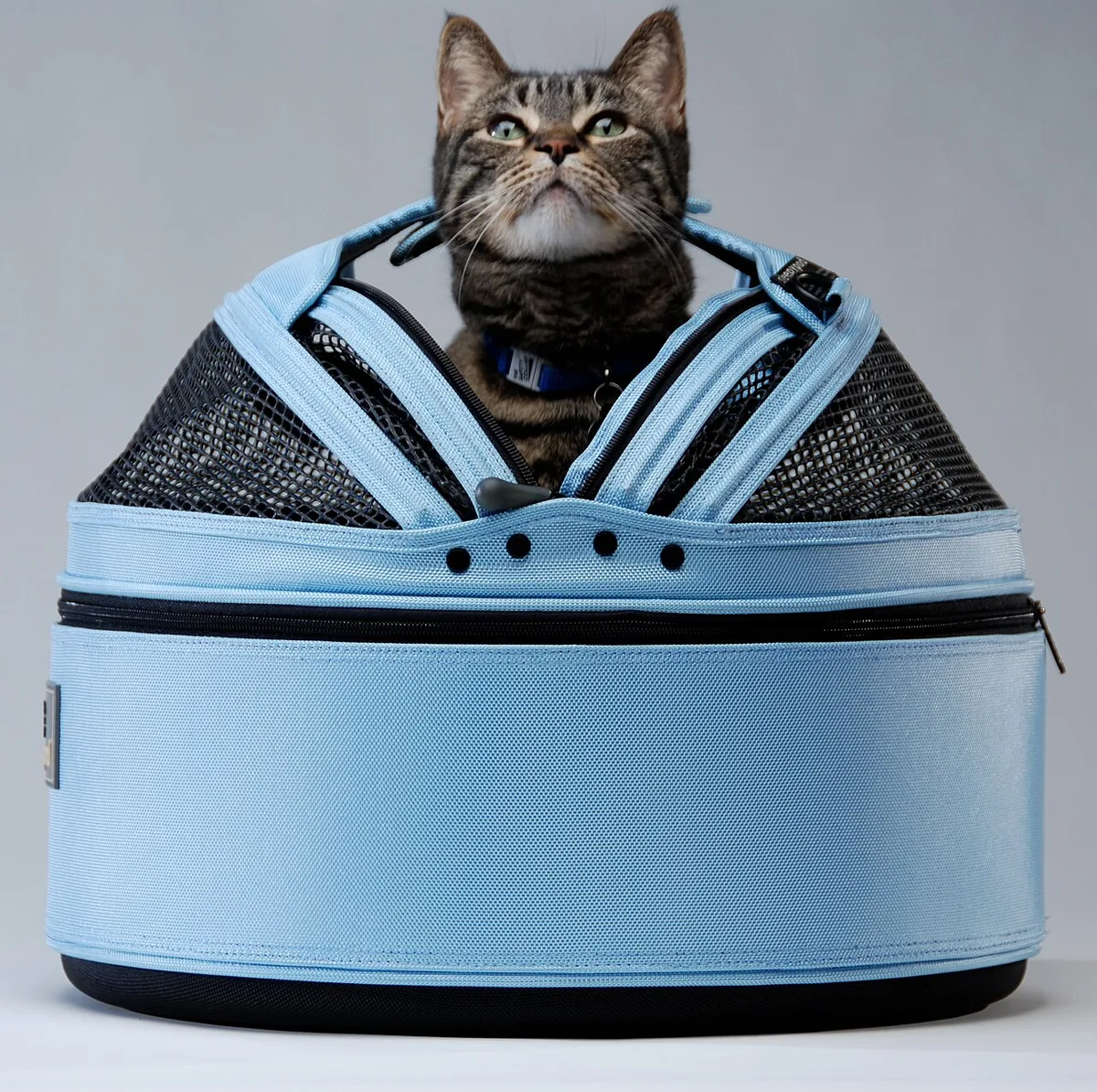
Soft-sided carriers have an edge in the cabin because they compress to fit under the seat, and most airlines allow a few extra centimeters of give. Measure your cat honestly: a cat that has to fold to fit the allowance will not cope with the day. The carrier needs enough room for the cat to stand, sit and turn around, with a solid, washable bottom.
Pack like the day is longer than the flight:
- Absorbent liner at the bottom, with a familiar towel that smells like home on top.
- An ID tag on the carrier itself, not just on the cat's collar.
- A copy of the health certificate and vaccination record taped inside the carrier lid or tucked into a side pocket.
- A small water bowl that clips to the carrier door, and a half-filled bottle of familiar water from home.
- Nothing loose inside: food bowls, toys and loose litter all turn into projectiles in turbulence.
Feed a light meal a few hours before the flight, not in the terminal. Freeze a small water bottle the night before so your cat drinks cool, familiar water through the travel day. Start the acclimation weeks, not days, before the flight. Leave the carrier open in the living room with a blanket inside, feed meals near it, then inside it. The goal is a carrier the cat walks into on its own. The airport is not the place for a first encounter.
Airport day
Arrive earlier than you think is necessary. Check-in staff will confirm the carrier fits their current dimensions, so have the policy sheet and confirmation printed or ready on your phone. Keep the cat in the carrier in the terminal. An airport lobby is a wall of noise, rolling bags and strange smells. Security screening is run by the airport and the national security authority, and procedures change. Instructions from the screening officer take precedence over anything you read online. In the common pattern, the carrier goes through the X-ray machine while the cat is carried through separately, which means the cat should wear a harness with the leash attached before you reach the front of the line. A harness beats a collar here: if the cat startles and bolts, a harness is what you grab.
Book a direct flight whenever possible to reduce handling and tarmac exposure at layovers. If you must connect, know where the pet relief area is at the connecting airport, and expect the cat to stay in the carrier for the whole connection. Board late if the airline allows it, so the cat spends less time confined under a seat. Offer water at the gate before boarding rather than in the cabin, and time the litter box and a light meal so the cat boards settled, not full.
After landing: the first night at your destination
Keep the cat in the carrier until you are in an enclosed space (a rental lobby, an elevator, or a door that closes behind you). Then set up the destination room before you open the carrier: litter box in one corner, water and food in another, and one quiet room with the door closed. Give the cat a full day of quiet. Offer water, keep the feeding schedule close to home, and resist the urge to force affection. A cat that hides under the bed for the first night is doing exactly what it should. The carrier, left open with the familiar towel inside, becomes the safe spot the cat retreats to. Keep the health certificate and entry documents within reach until you know no one needs to see them again.
Keep the destination routine close to home for the first week: same feeding times, same litter, same brand of water if possible. If the cat stops eating, or the hiding goes on for more than two days, a local vet visit is the right next step. The health certificate and medical history you carried are exactly what that vet will ask for. What to do in the next 24 hours: call the airline and read the current policy sheet aloud against your booking, measure the carrier with the cat inside it, book the vet appointment so the health certificate lands inside its validity window, and start a daily hour-long session with the carrier open in the living room.
Questions owners ask before flying
Can I give my cat a sedative for the flight? The ASPCA advises against tranquilizing pets for air travel, because sedation can hamper breathing, especially for flat-faced breeds. If you expect a nervous traveler, ask your vet about alternatives well before the trip.
What if my cat and carrier exceed the cabin allowance? Cabin travel is likely off the table, and you will be choosing between cargo and ground transport. The ASPCA's guidance is blunt: unless your pet is small enough to ride under the seat in front of you, air travel is best avoided.
Do I need a health certificate for a domestic flight? Requirements vary by airline and destination. The ASPCA recommends a health certificate dated within 10 days of departure, and some routes require one. Confirm with your vet and your airline, and get the timing in writing.
Can I take my cat out of the carrier during the flight? No. Pets must stay in the carrier under the seat in front of you for the whole flight. Taking a cat out mid-flight is against policy on essentially every airline, and in an emergency it is the worst possible time to have a loose cat.
My connection is with a different airline. Whose policy applies? The operating carrier's policy applies for each leg. Check both airlines' rules before you book. A carrier that fits airline A may exceed airline B's allowance.
How far in advance should I book the pet slot? As soon as you book your seat. Cabin pet allowances are limited per flight and can sell out before seats do. Some airlines open the booking window months out, others weeks. The booking-window row on your policy sheet answers this for your exact dates.
Sources we relied on
- ASPCA: Travel Safety Tips: https://www.aspca.org/pet-care/general-pet-care/travel-safety-tips
- Federal Aviation Administration: Flying with pets: https://www.faa.gov/travelers/fly_pets
- American Veterinary Medical Association: Pet care resources: https://www.avma.org/resources-tools/pet-owners/petcare
- Cornell Feline Health Center: Feline health topics: https://www.vet.cornell.edu/departments-centers-and-institutes/cornell-feline-health-center/health-information/feline-health-topics
- Ready.gov: Pets: https://www.ready.gov/pets
- Your airline's official pet policy page. Verify before booking. Airline-specific numbers are not stated here on purpose: they change frequently, and the carrier's current written policy is the only binding source.
This guide is travel planning information, not a veterinary opinion about your cat. Before you fly, ask your own veterinarian whether cabin travel suits your cat's health, and if your cat shows signs of illness or distress during or after the trip, contact your vet or an emergency animal clinic immediately.