Daily Care & Feeding
Small vs. Large Breeds: What Actually Differs in Daily Care
Published September 13, 2026Last reviewed September 16, 2026
Size changes more than the bowl. How far a small dog can safely walk, how portions are measured, how a dog is carried, what outdoor hazards look like and when senior checks start all shift with size, and this guide compares those routines side by side.
Where size changes careAging clockEnergyCarryingFeedingOutdoor safety
Size predicts some things about daily dog care (when aging starts, how much food to pour, how to lift safely) and almost nothing about personality. A calm giant and a whirlwind toy breed can live in the same block. This guide compares the care tasks that genuinely change with size, using small breeds such as the Chihuahua and large breeds such as the Great Dane as reference points.
No size wins here. A stocky small dog can out-eat a slender large one, and breed variation overrides the label.
Size predicts the aging clock
Timing is one of the most practical differences, and it moves the whole care schedule. Small breeds generally enter their senior years around ten to twelve years of age. Giant breeds may be considered senior at five or six, which means a Great Dane's owner is managing joint checks and adjusted exercise while a Chihuahua's owner is still buying puppy food. That gap shifts everything downstream: senior care, twice-yearly vet visits, and mobility conversations all start earlier for a large dog, even if the large dog acts young. For a large-breed owner, the calendar fills up with joint and mobility check-ins first, while a small-breed owner watches teeth and weight for years before the senior label applies.
Start the senior conversation with your vet years before the dog looks old. The senior dog care guide covers the adjustments that follow.
Daily care at a glance
| Care area | Small breeds (e.g., Chihuahua) | Large breeds (e.g., Great Dane) |
|---|---|---|
| Aging timeline | Senior years typically begin around 10–12 | Senior years can begin at 5–6, and joint checks matter earlier |
| Walks & exercise | Short walks suffice for many, but energy varies hugely by breed, and indoor play counts | Needs daily exercise, but not necessarily more than a terrier, fit the breed, not the label |
| Feeding & treats | Small portions and easy to overfeed, so measure by weight | Larger portions. A single extra treat makes less difference per kilogram, but total calories still need control |
| Outdoor safety | Vulnerable to cold, predators (raptors, larger dogs) and being underfoot, so carry when needed | Stronger in the cold, but needs secure, tall fencing and a leash that can physically control them |
| Handling & carrying | Support the chest and hindquarters together, and never lift by the scruff or limbs | Do not pick up casually, because a struggling large dog can injure the handler and itself, train cooperative handling instead |
| Bedding & home | A crate-sized bed and a low step-up are often enough | Needs a large orthopedic bed, low furniture access (ramps), and headroom in the car |
| Vet check-ins | Senior screening later, but dental and weight checks from the start | Start joint and mobility conversations and growth-phase nutrition early, puppyhood to adulthood matters |
Every row in this table is a tendency, not a law. Your dog's breed mix, age, and health history set the real numbers, so discuss them with your vet. One thing does not change with size: the fundamentals. Fresh water always available, regular weigh-ins, dental care, and vet visits that start senior screening at the right age for that size. Emergency planning scales too, so know your nearest emergency clinic and keep a first-aid kit sized for your dog, not a generic one.
Energy and exercise: don't assume the label
Small does not mean lazy, and large does not mean athletic. Terriers and herding breeds, many of them small, have enormous energy needs, while some giant breeds are famously calm. Exercise should be matched to the individual dog's breed and condition, then adjusted by how the dog actually behaves on a walk. If your small dog pulls and bounces for an hour, plan for an hour. If your large dog strolls happily and naps, do not force a marathon to earn its size.
A walk is a conversation between you and the dog, and the dog answers first.
As a rough starting point, many adult dogs do well with 30 to 60 minutes of purposeful exercise a day, but the label tells you nothing. A Jack Russell and a Great Dane can both want more. A French bulldog and a Greyhound are both sprinters, not marathoners. Watch the behavior after the walk: a dog that paces or countersurfs is telling you the walk was too short, whatever the breed standard says. Fit the length to the dog, not the calendar.
The environment changes what exercise means at each size. A small dog can get a surprising amount of movement indoors, from a hallway fetch session to a puzzle feeder or a few laps of the stairs, which matters when the weather is extreme. A large dog needs room to actually move, and a hallway is not a walk for a breed built to cover ground. For both, the pavement check applies: if the ground is too hot for your hand, it is too hot for paws, whatever the size of the paw.
Carrying, handling, and car rides
Small breeds. The risk is being dropped, stepped on, or carried incorrectly. Lift with one hand supporting the chest and the other under the hindquarters, keeping the spine level. Never lift by the scruff or the front legs, and teach children that a small dog is not a toy. Outdoors, the hazards are real: hawks, larger dogs, and even busy doorways, and a small dog underfoot in a crowd is one misstep from trouble.
Large breeds. The risk is the opposite: trying to lift what should not be lifted. A large dog that cannot be carried should instead learn cooperative handling, stepping onto a scale, into a car, or up to a grooming table on command. If lifting is truly necessary, such as in an emergency, get instruction from your vet or a trainer first. Lifting a heavy dog with a bent back can hurt both of you.
For the emergency lift of a heavy dog, the safe pattern is a team effort: one person supports the chest, another the hindquarters, and both move together on a count. A sling or a folded blanket under the belly spreads the weight and protects the handler's back.
Practice the moves before the emergency. An untried technique fails exactly when it is needed.
Transport differs too. A large dog needs a crash-tested restraint sized for its weight and a vehicle with headroom. A small dog needs a carrier or restraint that keeps it from becoming a projectile in a sudden stop. In both cases, choose the restraint for the dog's actual weight, not the breed name on the paperwork. Re-check the fit each season, because dogs change shape faster than the labels on their paperwork do.
Feeding: portions, growth phase, and treats
- Portions follow energy needs, not just size. Two dogs of the same size can need different calories based on activity and metabolism. Measure by weight and adjust with your vet.
- The growth phase is the high-stakes window for large breeds. Large-breed puppies are sometimes fed differently to control growth rate and reduce developmental joint stress. Your vet should set the actual plan for your puppy.
- Treats scale with the dog. A small-dog treat ration can be a whole meal's worth of calories for a tiny dog, while a large dog's training treat can be almost invisible. Count calories either way.
- Small dogs are easy to overfeed. Their maintenance calories are low, and a few extra treats add up quickly.
A measuring cup is a starting point, not a system. The same dog's needs change across seasons, activity levels, and life stages, so weigh regularly and let the vet set the calorie target.
Water matters more than the bowl. Raised bowls at a comfortable height spare the neck of a large dog, while a small dog should have water on every floor it uses, since a Chihuahua may simply skip the trip downstairs for a drink. Watch intake too: a dog that drinks noticeably more or less than usual is a reason to call the vet, not a mystery to solve at home. Expect thirst to climb with exercise and hot weather, which is ordinary. Sudden changes in drinking habits belong in the vet conversation, not in a bowl-size discussion.
Gear, home access, and the outdoor world
Crates, beds, and bowls scale too. A small dog fits a travel crate, while a large dog needs a crate you can stand beside and bowls raised to spare the neck.
The car is where size surprises people most. A Great Dane in a compact car is a logistics problem, and a Chihuahua in the same car is a passenger safety problem if it is loose, so plan the restraint system before the trip, not during it. Home access changes too. A small dog can use stairs freely but may need a step up to the couch, while a large dog may manage the couch easily but needs ramps for the car and the bed. Both sizes benefit from a floor plan without surprises in the dark.
Grooming tools scale too. A pin brush sized for a large dog's coat is clumsy on a small one, and a slicker that fits a Chihuahua's ear will take all afternoon on a Great Dane. Nail care matters at every size, but small dogs often need it more often because their nails grow proportionally faster against shorter legs. A senior small dog with overgrown nails changes how it walks.
Outdoors, size changes the risk profile in both directions. A small dog is easier to lift out of trouble but easier to lose in a crowd and more vulnerable to larger dogs, birds of prey and cold weather. A large dog commands space, which helps in crowds, but pulls harder on the leash, needs more room to maneuver and can be intimidating to other dogs even when friendly.
The leash is where size shows first. A small dog can be managed with a light leash and collar or harness, and the choice matters more for comfort than for control. A large dog needs gear that can physically hold it, which usually means a well-fitted harness attached to a leash you can grip with both hands. Whatever the size, a leash that stretches or snaps under pressure is a safety issue, not a fashion choice. A harness that spreads pressure across the chest beats a collar for walks at both sizes, and the difference shows most when the dog pulls hard or the pavement is slick.
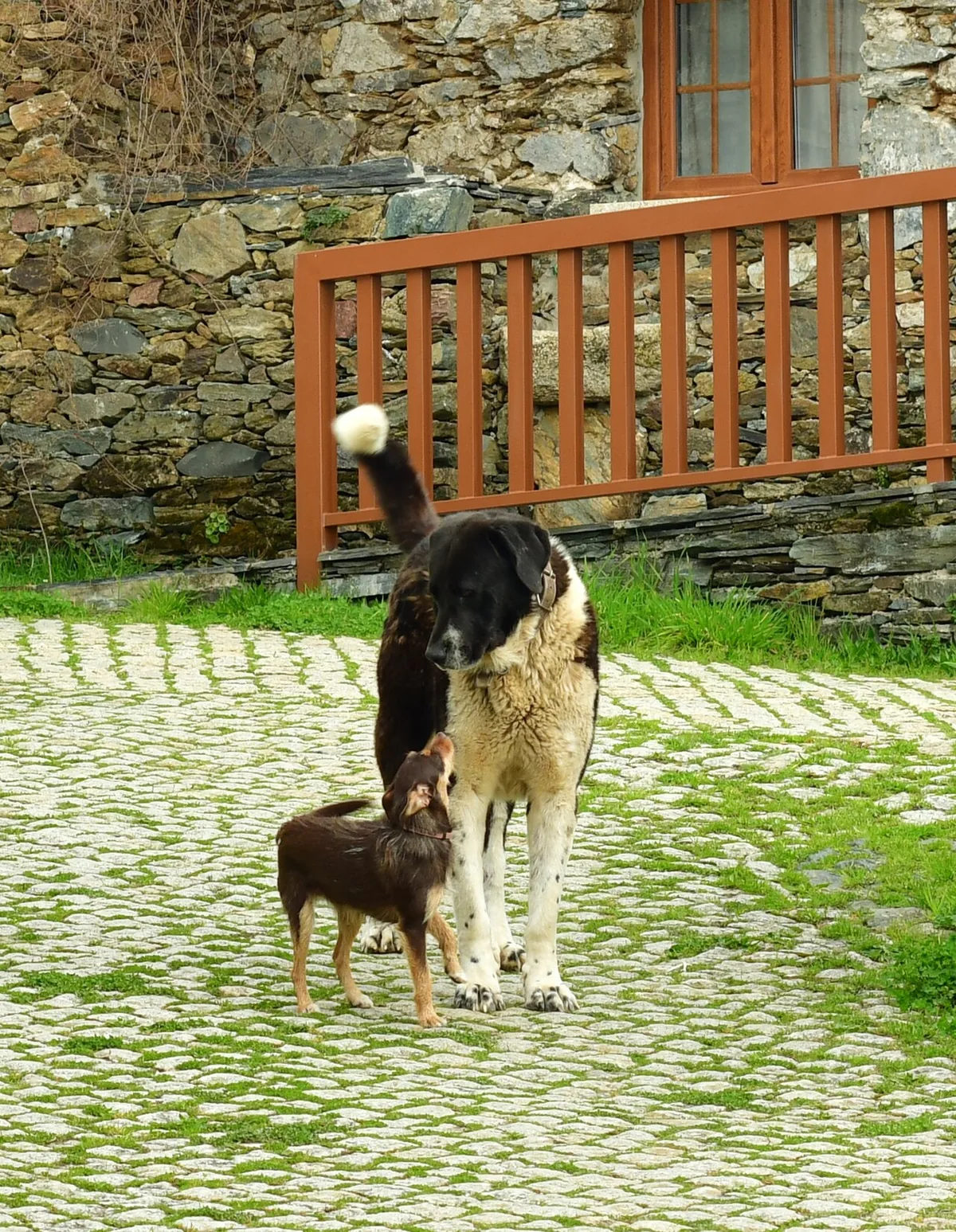
A small dog and a very large dog at play is a mismatch, so pick the right park section or hours and keep small dogs close.
Common mistakes at both ends of the scale
Feeding by eye is the quietest mistake, and it drifts in one treat at a time. Small dogs get overfed because a handful looks small, and large dogs get overfed because a handful looks reasonable, so both end up with a weight problem the same way. Lifting is the most visible mistake, and it runs in both directions: owners of large breeds sometimes try to lift a dog heavier than they can safely manage, while owners of small breeds sometimes lift constantly until the dog never learns to move on its own. Both habits deserve a handling plan, not a routine. Plan the handling before you need it and put weigh-ins on the calendar, and most of these mistakes never get a chance to start.
Meet the dog in front of you, and let the vet set the health milestones.
Training method stays the same at every size. A reward-based approach works for a Chihuahua and a Great Dane alike, and both benefit from early handling practice so exams, nail trims, and car rides are not surprises later. Start young and keep sessions short.
Three moves to make in the next 24 hours: weigh your dog, compare the food bag's feeding guide against that number, and book a vet visit to set a calorie target and a senior-screening schedule that fits your dog's size. Write the number down.
Size questions owners ask most often
Is a small dog easier to care for than a large one? Different, not easier. A small dog is simpler to lift and house but easier to overfeed and easier to injure by accident. A large dog costs more to feed, needs more room and stronger gear, and needs an earlier senior conversation. A small dog takes less space and costs less to feed, which suits some homes, while a large dog fits households with room to move and hands to handle it. The honest answer depends on your home and your routine.
When does my dog become a senior? It depends on size and breed. Small breeds typically enter their senior years around ten to twelve, while giant breeds can be considered senior at five or six. Ask your vet for the number that fits your dog, then let it set the schedule for senior bloodwork and joint checks. The calendar number matters less than what your vet sees at the exam.
How much should I feed my dog? Weigh, don't guess, and let your vet set the calorie target.
Should I pick a dog based on size? Size predicts the care load, not the personality. A tiny dog and a giant can both be calm or frantic. What size reliably changes is the food bill, the gear, the aging schedule, and the handling skills you need, so choose for the daily reality, not the photo.
My small dog gets cold on winter walks. What helps? A well-fitted sweater or coat, shorter walks, and indoor exercise on the coldest days. Check paws and belly for snow, salt, and ice.
Do large dogs cost more to keep? Usually, and the gap is bigger than the food bowl. Larger portions, bigger crates and beds, larger doses of preventives, and a car that fits them all add up. The savings run the other way too: a small dog's "tiny" overfeeding is proportionally huge, so a smaller dog is not automatically cheaper to keep at a healthy weight. Whichever size you live with, keeping the dog at a healthy weight is the one budget move that works everywhere.
Where the facts in this guide come from
- AVMA, "Caring for Your Pet", https://www.avma.org/resources-tools/pet-owners/petcare
- AVMA, "Senior Pets", https://www.avma.org/resources-tools/pet-owners/petcare/senior-pets
- ASPCA, "Dog Care", https://www.aspca.org/pet-care/dog-care
- AKC, "Expert Advice: Nutrition", https://www.akc.org/expert-advice/nutrition/
- AKC, "Chihuahua Dog Breed Information", https://www.akc.org/dog-breeds/chihuahua/
- AKC, "Great Dane Dog Breed Information", https://www.akc.org/dog-breeds/great-dane/
This guide is general information, not a veterinary opinion. Talk through your dog's health, diet, and behavior with your own veterinarian before acting on anything you read here. If you believe your dog is in an emergency, call your vet or the nearest emergency animal hospital right away.